July 19, 2026 Update: They’ve given a higher reward for some matches, e.g., guessing third place right got you 5x. Now, final is getting you 8x multiple, which turns into 12% cashback for no-fee card. If you do the paid card, you can get as high as 24% cashback! Details in this tweet.
June 19, 2026 Update: I can confirm that they pay out referral bonuses to both parties. Importantly, they currently have a 2% cashback bonus for 24 hours after correctly predicting individual FIFA World Cup Games. Essentially, this means the free card, which typically earns 1% cashback, now earns a net 3% cashback bonus. Since there are enough individual games, you will have plenty of opportunities to get it right. If you were interested in this card, this is a good time to join for an easy 3% cashback bonus, on top of the referral bonus. Further details at https://www.kast.xyz/matchday
May 17, 2026 Update: Both the referrer (see left image below) and the referred user (see right image below) can earn up to $250 per signup. The “spend $100 to earn $20” bonus is activated immediately, and you have 7 days to complete this activity. The remaining offers, an additional $30, $50, and $150, must be activated separately, and you will have 7 days to complete the offer from activation. This is a limited-time promotion ending on May 31, 2026. The free card earns 1.5% cashback, which is awarded in addition to your spending bonus. The effective cashback rates for exactly completing each offer (with 1.5% cashback) are as follows: 21.5% on $100 in spending, 9.83% on $600 in cumulative spending, 7.75% on $1,600 in cumulative spending, and 5.25% on $6,660 in total spending. More details on their promotion can be found at: https://www.kast.xyz/blog/the-more-you-refer-the-more-you-earn


May 9, 2026 Update: KAST cards seem to have lucrative cash bonuses for completing tasks. See below (details in their help page):

As mentioned in an earlier post, I have been searching for a “fun” debit card to replace my existing ones. I recently reviewed the 1% and 3% debit cards from MetaMask, Uphold’s generous 2% and 4%, and relatively unknown 4% debit card from Amp Pay (dead), as well as Ether Fi’s 3% card, which at the time featured a generous 15% cashback promotion. In this post, we will discuss the KAST debit card.
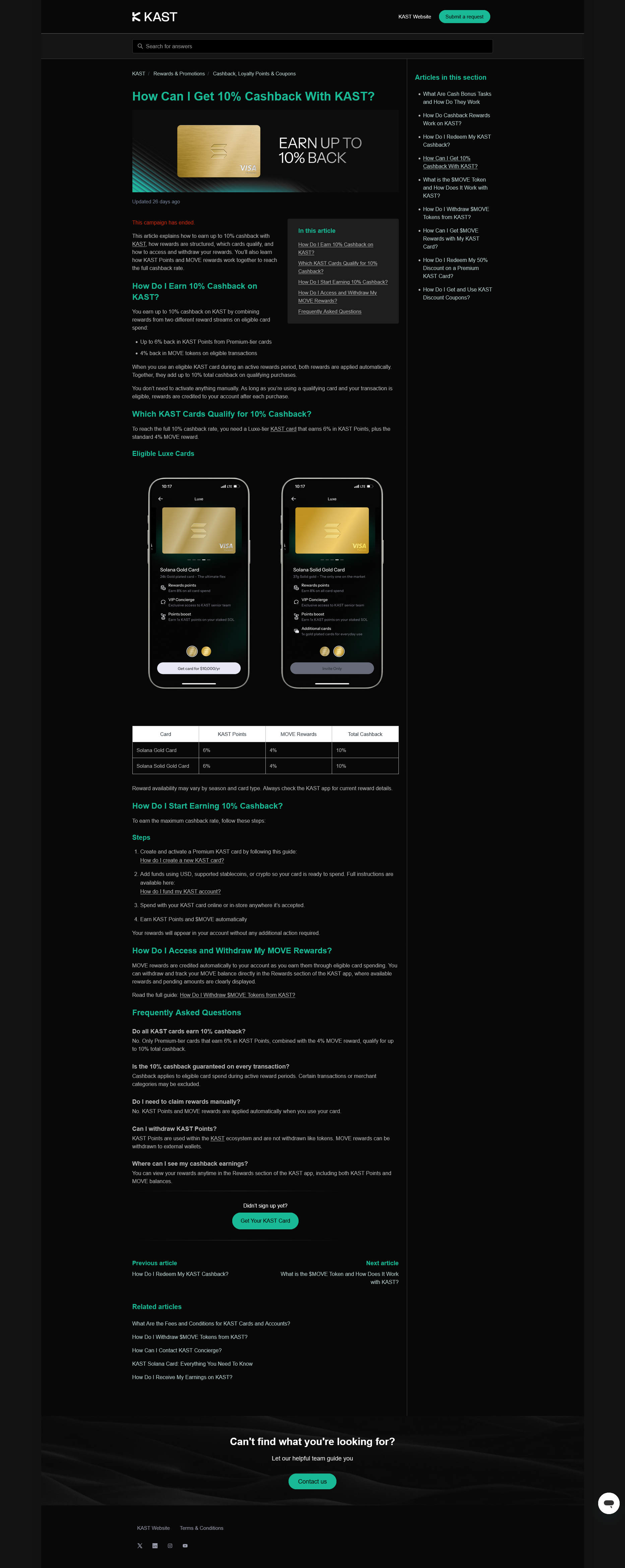
First things first, KAST is a cryptocurrency platform. They recently raised $80 million in Series A funding (read about it in their blog post here). Second, as recently as last month, KAST ran a limited-time promotion offering 5% cashback on a no-annual-fee card and up to 10% cashback on its premium version (see this saved screenshot). But it also had a higher cashback rate on annual fee cards. Obviously, cards could be buffed again, but in its current form, the KAST debit card lineup feels underwhelming and largely uncompetitive, which is what this review will focus on.
If you’re interested in joining KAST, we would appreciate it if you could support the blog and join KAST with this code ZCVSGWUB or link
https://app.kast.xyz/referral/ZCVSGWUB
Three Tiers of Cards
KAST offers three tiers of cards: Standard, Premium, and Private. Like most newer crypto debit cards, such as MetaMask, Uphold, and Amp Pay, KAST ties higher cashback rates to an annual fee rather than requiring users to stake crypto. That’s a notable shift from the older model used by cards like Crypto.com (CDC) and CoinZoom, although even CDC now also offers an annual fee option alongside its staking-based structure. That said, KAST pushes this model much further than most. The Premium tier comes in at $1,000 per year, while the Private tier costs a steep $10,000 annually.
Some of the key benefits for each tier are shown in the screenshot below. For convenience, I’ve also summarized them in the table below, along with the associated fees based on information from KAST’s website (see this screenshot). Each tier also comes with a selection of different card designs.
| Standard Card | Premium Card | Private Card | |
| Annual Fee | None | $1,000 | $10,000 |
| Cashback Rate | 1.5% (first $2,000/month qualifies) | 2% (first $10,000/month qualifies) | 3% (first $50,000/month qualifies) |
| Card Type | Card Type | Visa Infinite | Visa Inifinite |
| KAST Points | – | +1% | +2% |
| Virtual Card | 2 free virtual cards | Free | Free |
| Physical Card | $40 | Free | 1 free Gold Plated Card |
| VIP Concierge | – | – | Exclusive access to KAST senior team |
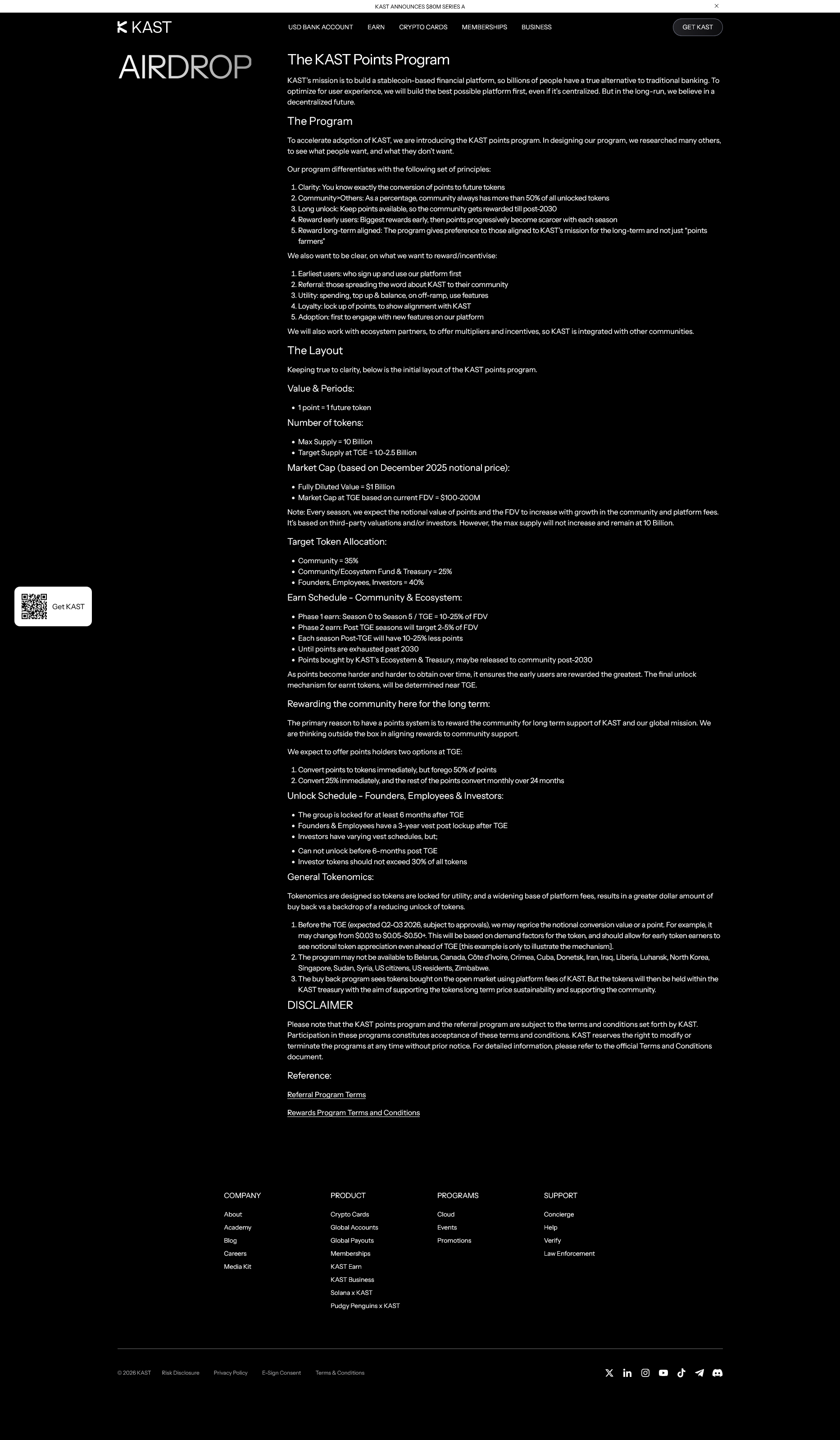
KAST Points, as I understand it, do not have immediate utility right now. They cannot be withdrawn like tokens or converted to cash. Instead, they are intended to convert into future tokens at a 1:1 ratio (read more at their website or this screenshot).
If you assume, which is a big if, that KAST Points are worth 1:1 with cash, then the effective cashback for each tier would be:
- 1. Standard: 1.5%
- 2. Premium: 2%+1% = 3%
- 3. Private Card: 3%+2% = 5%
Of course, once KAST Points eventually convert into a token, that token could be worth more or less than face value. If it ends up appreciating, the rewards could be worth more than 1% of the spend. If it depreciates, that same 1% bonus could effectively be worth 0.5%, or even less. In other words, the real value of the KAST Points bonus remains highly uncertain.


Closing Thoughts
You would be insane to pay $10,000 in annual fees for a 3% cashback card (with an additional 2% awarded as KAST Points) with a monthly cashback cap, especially when the market is saturated with 3% or higher crypto-based cards (such as Ether Fi and Uphold, Coinbase) as well as traditional cards (such as Robinhood, Altitude Reserve). Nevertheless, KAST is worth keeping an eye on just in case they offer a generous promotion again and/or revamp their card offering to be very competitive.
Having said that, cash bonuses for meeting various tasks are good bonuses and might be worth the effort. Specifically, spending $100 to get $20 turns into 20% cashback, while spending $500 to get $30 turns into 6%, and spending $1000 to get $50 turns into 5% cashback. All of this is in addition to the cashback you typically get from your KAST card.